

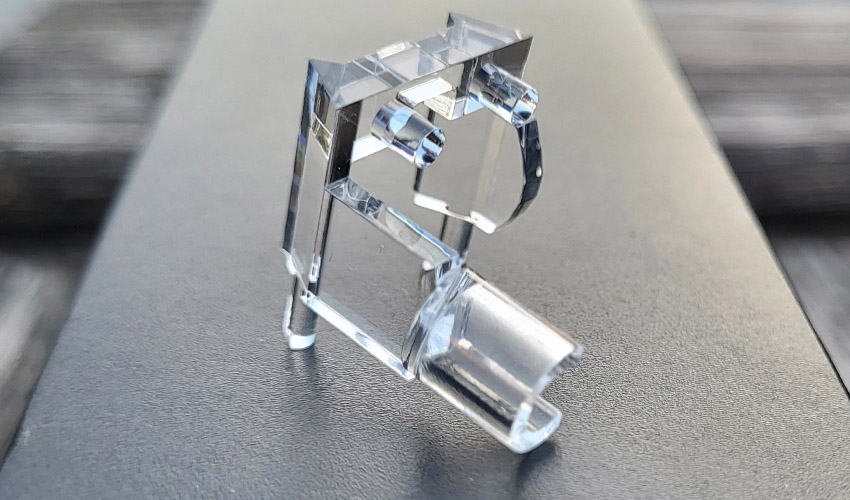
Custom Optical Light Guides: Types, Manufacturing, and Applications
Types of Optical Light Guides
|
TYPE
|
DESCRIPTION
|
Key Characteristics
|
|---|---|---|
|
Fiber Optic Light Guides
|
Bundles of non-coherent optical fibers (glass or plastic) that transmit light via total internal reflection (TIR). Can be rigid or flexible.
|
High transmission in visible/near-IR; suitable for imaging; available in single, bifurcated (Y-shaped), or multi-legged configurations.
|
|
Liquid Light Guides
|
Flexible tubes with a liquid core sealed by quartz windows, ideal for UV or high-intensity light.
|
Minimal loss over distance; excellent UV transmittance (down to 220 nm); no fiber breakage risk; more durable than fiber bundles.
|
|
Solid Dielectric Light Guides
|
Molded or machined from transparent plastics (e.g., PMMA) or glass slabs/rods for TIR-based guidance. Includes planar (flat-panel) and prismatic variants.
|
Compact for backlighting; customizable shapes (bent, tapered); used for edge-lit designs.
|
|
LED Light Pipes
|
Rigid or flexible pipes designed to channel LED light to indicators or panels, often with colored options.
|
Low-profile; multi-color variants; connects LEDs to remote display areas.
|
|
Hollow Reflective Light Guides
|
Tubular structures with internal reflective coatings (e.g., mirrors or prisms) for light channeling.
|
Efficient for daylighting or long-distance transport; less common in compact optics.
|
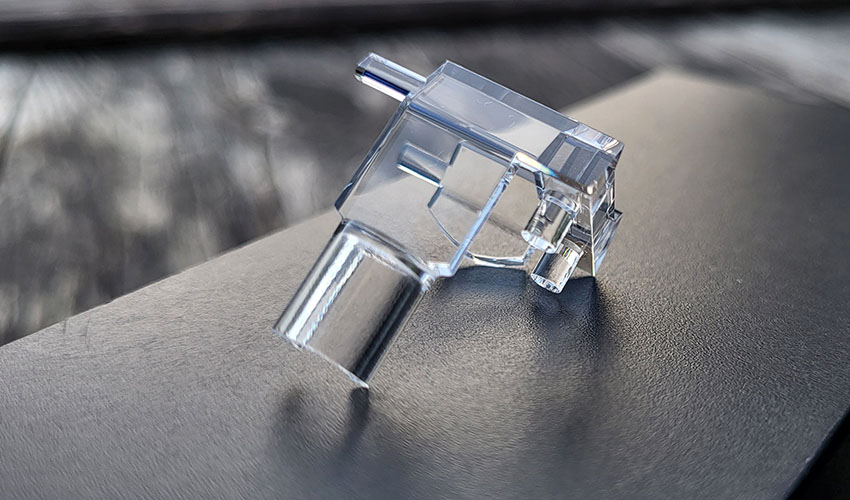
Manufacturing Methods: CNC-milling and Optical 3D Printing
Process 1: CNC Milling
-
- Material Selection: Start with high-transmission blanks like PMMA, PC, or Zeonex selected for refractive index (typically ~1.5) and low absorption.
- Precision Shaping: Employ 3- to 5-axis CNC mills with diamond-tipped tools (e.g., ball-end mills, fly-cutting tools) for intricate features. This includes:
- Rough milling for overall geometry (e.g., cylindrical rods or bent slabs).
- Fine milling at high speeds (low feed rates) to form extraction prisms, tapers, or edge-lit surfaces, avoiding cracks in brittle materials.
- Advantages: Enables one-clamping production of complex shapes (e.g., S-shaped guides up to 600 mm long), with low tolerances. Vibration-free machines and coolant lubrication prevent defects.
- Unique Diamond Polishing Approaches:
- Our unique CNC + Diamond Polishing approach ensures that any visible layering – as it may appear from the CNC-process – gets totally eliminated
- Diamond Milling with Annular Cutting: For arrays or freeform lenses, spherical diamond tools create aspheric profiles via annulus cuts, ensuring uniform light distribution.
- Hybrid Polishing: Post-milling, apply chemical-mechanical polishing (CMP) with diamond slurries for flatness, combined with hand-figuring for custom defects.
- Quality Control: Laser interferometers and profilometers verify surface finish throughout, yielding defect-free parts with high repeatability.
Process 2: Optical 3D Printing
In close cooperation with our affiliated venture Luximprint, we utilize advanced optical 3D printing methods to generate optical light guides, most notably Light Guiding Plates and other elements. The printing process allows for a fast, flexible and cost effective approach, it greatly combines with the EXXELENS approaches. Optical 3D printing enables production of complex shapes (e.g., S-shaped guides up to 650*650 mm long), with low tolerances. Surface complexity, as such, doesn’t matter.
Interestingly, we can also follow a more ‘hybrid’ manufacturing approach where, for example, the bulk of the job is done through CNC-milling, yet the refinement or finishing of the parts by optical 3D printing. As such, we take benefit from the distinct benefits each of the processes offer, and combine it into a truly unique and attractive solution. In a future blogpost, we will further elaborate on this.
Process 3: Vacuum-Casting
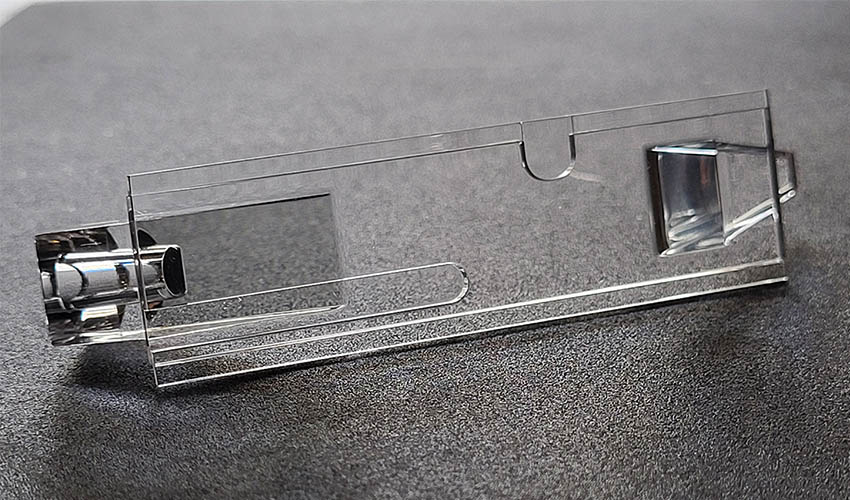
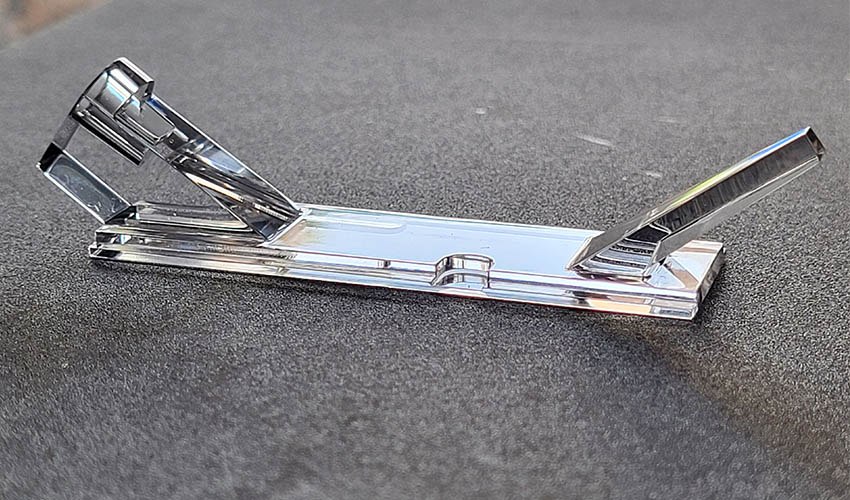
Key Applications and Uses
- Automotive Lighting: Prismatic solid guides for stylish LED headlights/taillights, instrument panels, and map lights; enable compact, energy-efficient designs with uniform illumination.
- Medical and Endoscopy: Flexible fiber or liquid guides deliver bright, cool light (UV-visible) for imaging, surgery, or UV curing; used in endoscopes, dental tools, and laser delivery systems.
- Industrial and Machine Vision: Ring lights or backlights from fiber bundles for microscopy, inspection, and spectroscopy; transmit from remote sources to avoid vibration/heat.
- Consumer Electronics: LED pipes for keypads, HMI panels, and displays; low-profile backlighting in handhelds or dashboards.
- Scientific and UV Applications: Liquid guides for high-power arc lamps in research (e.g., fluorescence microscopy) or curing processes; hollow variants for daylighting in buildings.
- Telecommunications and Sensing: Fiber-based for long-distance signal transmission or sensors in harsh environments (e.g., MRI-compatible powering).